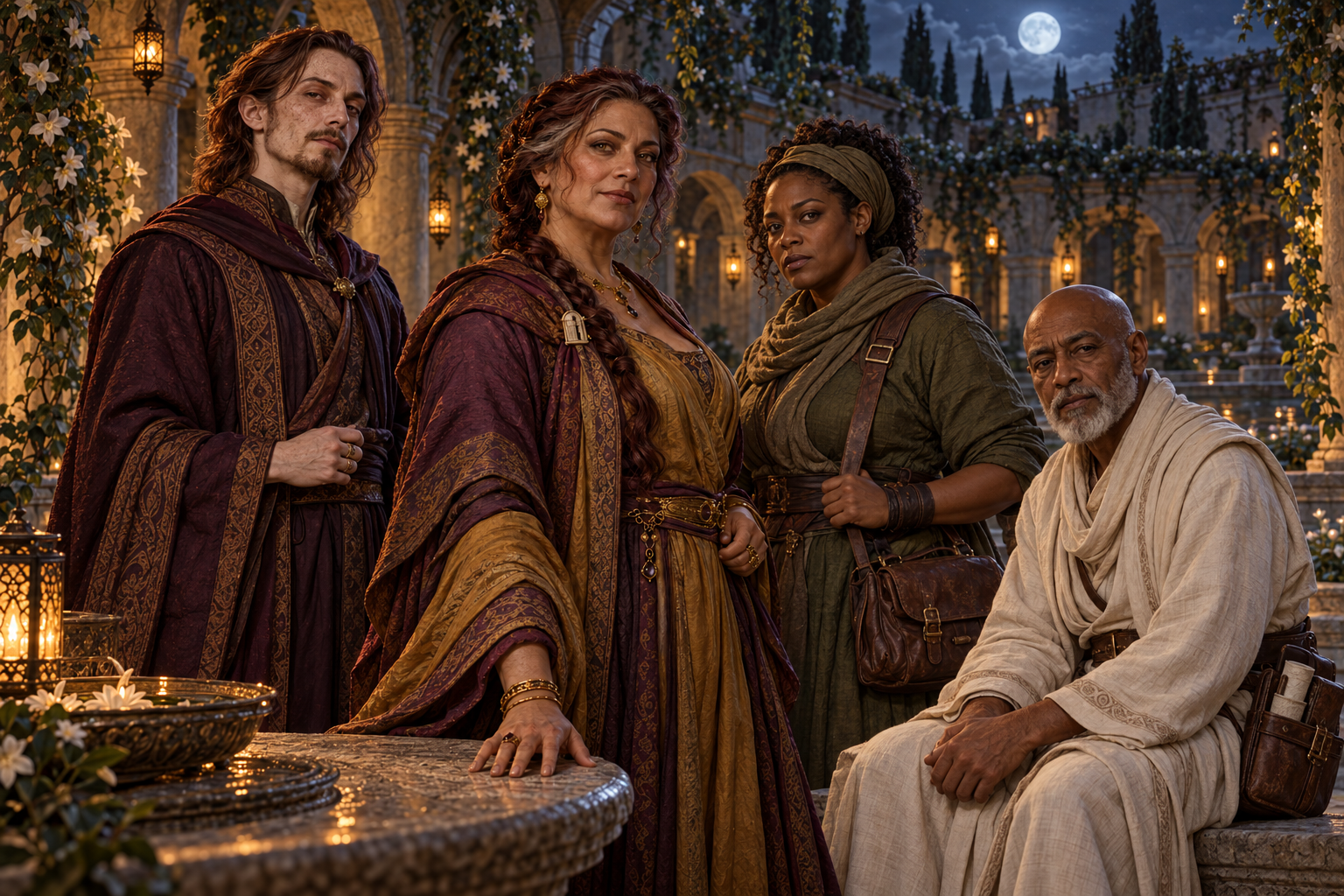
Character, holdings, and sigil
Harrow is a wealthy network of merchants, traders, tinkerers, guesthouses, and intermediaries. It has the most regular contact with the mortal world and can move goods, money, news, old books, and recovered artifacts between people who would never meet directly. Its members prefer bargaining and practical accommodation to violence.
The Lantern Court retains its sunken garden, night-blooming flowers, public suppers, and private meeting rooms. Its invitations offer genuine hospitality; accepting a room does not secretly surrender a guest's freedom. Isolde's maxim is “There is always a place for you.” The hexagonal sigil holds an ivory open doorway, understood as an opportunity taken when offered.
Other houses may call Harrow common-born or unserious. That judgment underestimates its money and connections. Harrow and Belrath are both exceptionally wealthy; their exact ranking is unsettled.
Harrow Members
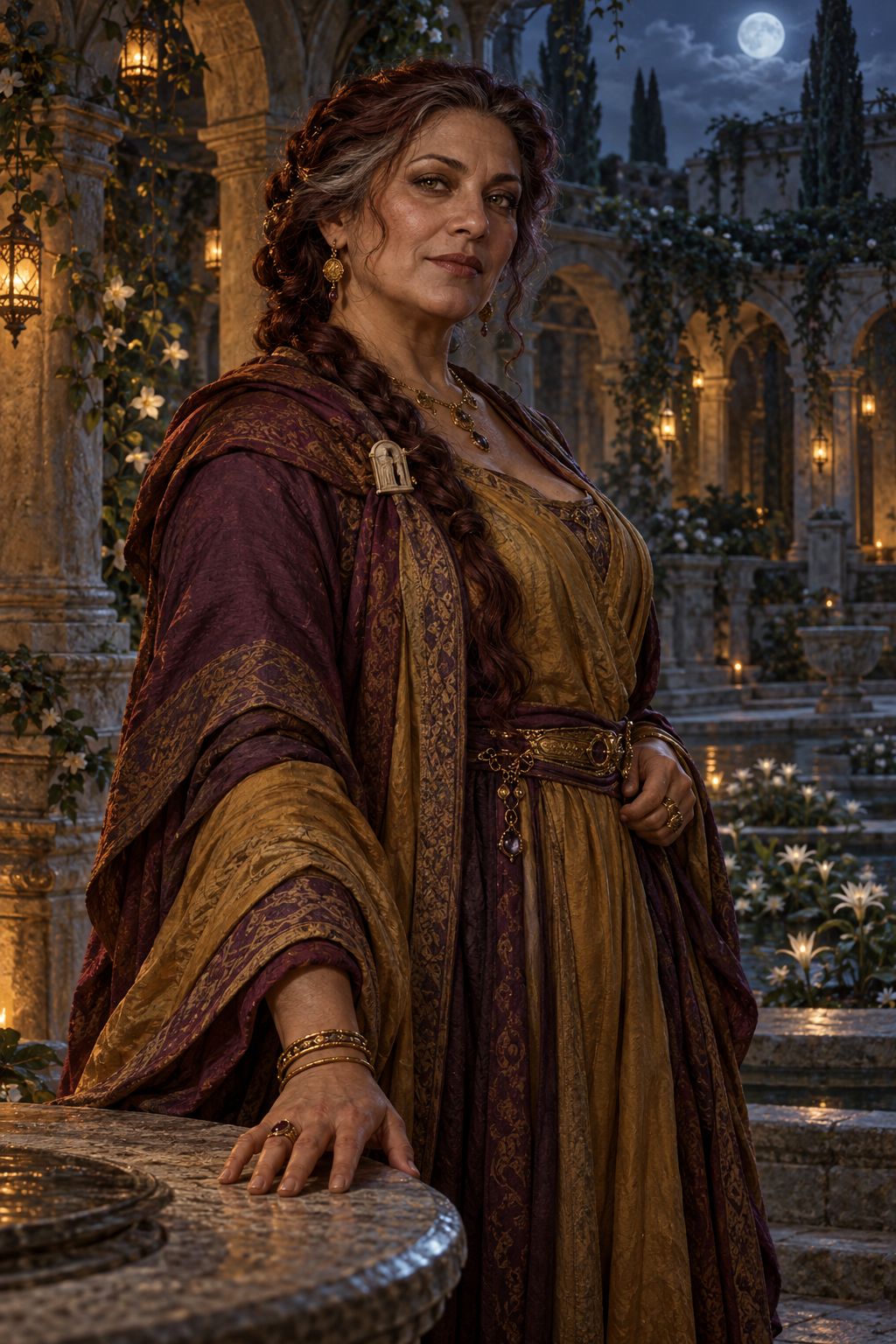
Lady Isolde Harrow — head and merchant patron
Warm, attentive, and difficult to embarrass, Isolde remembers clients and absent relatives. She is the gracious face of a consent-based trading house. She enjoys influence but protects confidential business rather than threatening dependents with homelessness to secure obedience. She considers Harrow more moral than its violent peers and can disarm an insult with courteous agreement. Her skill is making an exchange possible while keeping useful people willing to return.
Isolde is a full-bodied woman appearing in her fifties, with warm light-brown skin, a broad face, and auburn hair braided low with visible gray strands. Saffron and plum fabrics, an ivory doorway brooch, and a small welcoming smile soften her watchful expression.
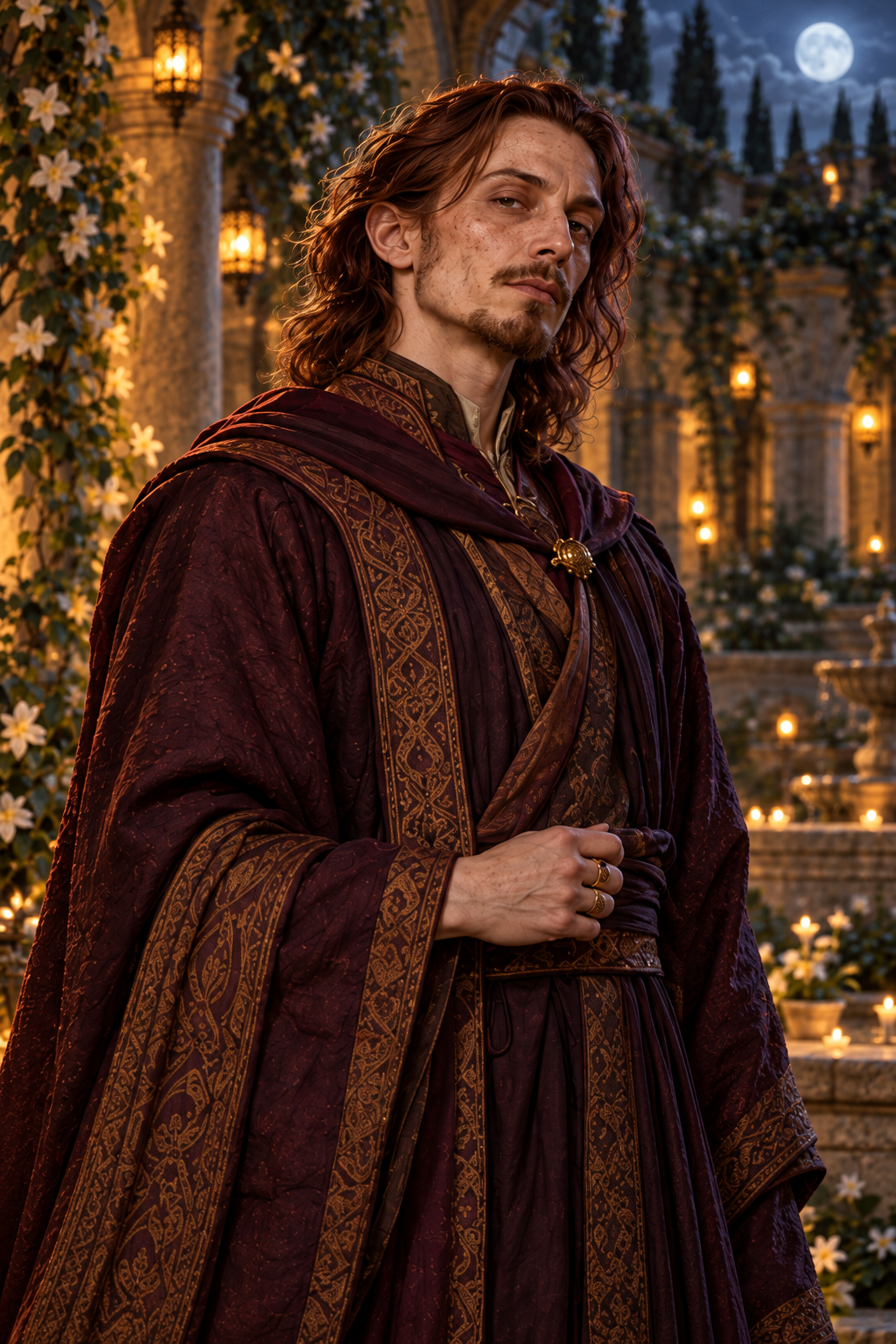
Master Peregrine Harrow — host and discreet contact
Peregrine oversees entertainment and visiting dignitaries. Nadia Bell and Brother Osric Bell rescued him after the proposed daylight incident, and he brought them into the household in gratitude. The details of that incident and daylight tolerance remain open. His composed manners make him useful at awkward meetings. He has a proposed intimate relationship with Corvin Koss, extended to Vera Drazek and Faris Reed. No betrayal by Peregrine is established.
Peregrine is a slender adult man with pale, lightly freckled skin, shoulder-length chestnut hair, and a narrow, neatly kept beard. Plum-and-bronze robes fall in graceful layers; his relaxed hands and composed expression give little indication of how closely he is observing the room.
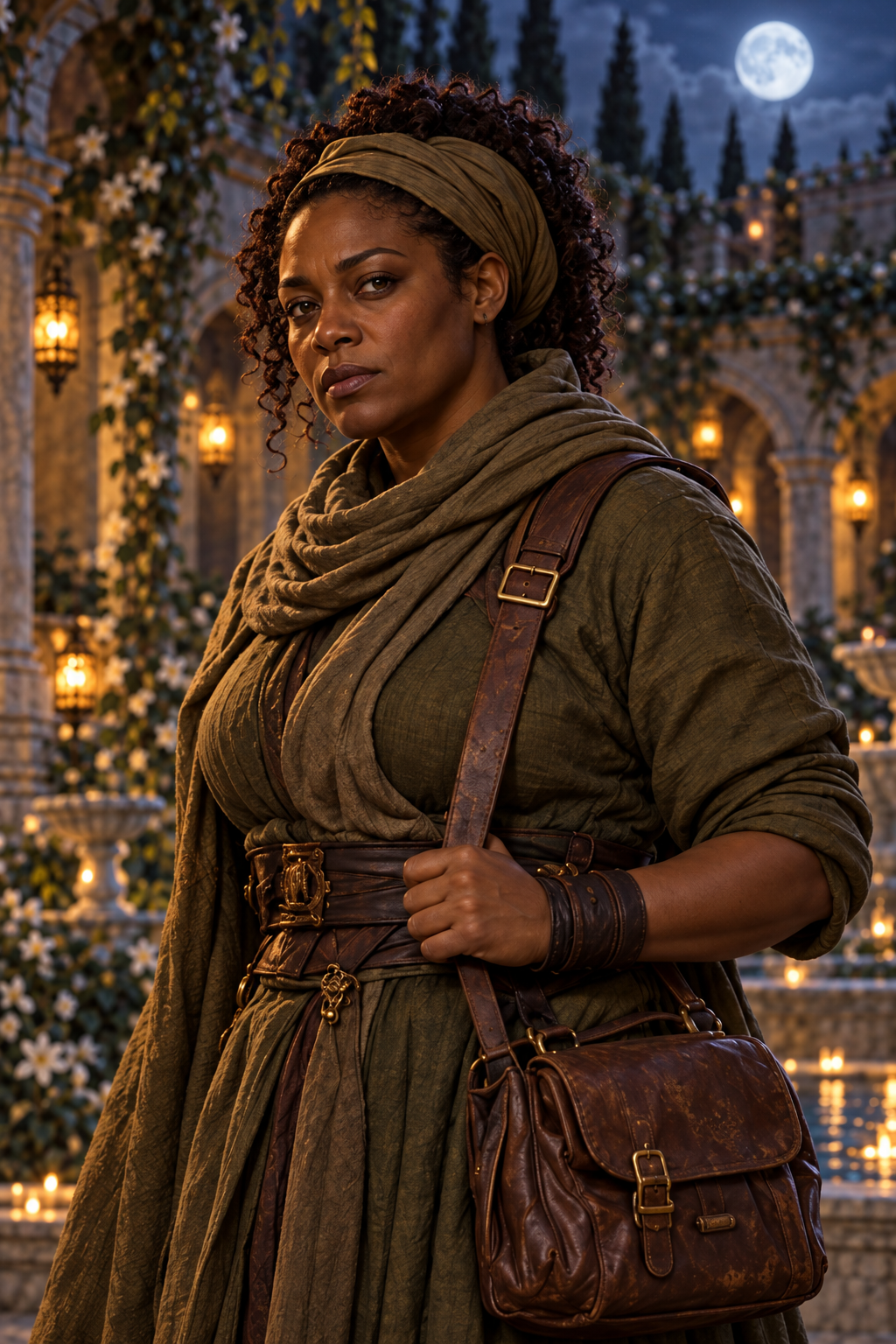
Nadia Bell (mortal) — organizer and information broker
Nadia is Brother Osric Bell’s eldest daughter. A former caravan cook, Nadia recruits innkeepers, porters, and other travelers through fair wages and mutual assistance. She knows the difference between an eyewitness account and a convenient rumor. Her part in rescuing Peregrine explains her standing beyond mere employment. She protects agents and clients rather than treating them as disposable sources. She seeks to reduce dependency within the household’s consensual trading practices.
Nadia is a sturdy mortal woman in her forties, with dark brown skin and tightly curled black hair held back by a simple scarf. Olive travel layers, a worn satchel, and a steady, protective gaze identify a working organizer rather than a courtier.

Brother Osric Bell (mortal) — physician
Osric is Nadia Bell’s father, and she is his eldest daughter. His rescue of Peregrine helped secure his place in the household. He treats donors, servants, and travelers and monitors whether blood exchanged for goods is being given willingly and safely. His religious affiliation remains unspecified. His medical notes may reveal abuse by outsiders. Osric can challenge a bad arrangement without exposing consent as a household sham.
Osric is a mortal man in his sixties, with brown skin, a bald head, and a short white beard. Unadorned off-white medical robes and a leather healer’s pouch accompany a calm, tired face. He wears no emblem establishing a particular religious affiliation.
Apparent ages do not establish the vampires' chronological ages.
Historical background
During the Cistern Siege, Harrow guesthouses sheltered survivors of several allegiances. Door books helped reunite relatives and locate witnesses. Those grateful connections became a trading network.
The Compact provides political protection for acknowledged dependents, including agents who never visit Lantern Court. Harrow argues that employment carries responsibility. Its reports still travel by couriers and travelers; influence does not make it omniscient, and Nadia distrusts information that arrives too conveniently complete.
Attitude toward mortals
Willing participation is foundational. Harrow trades in blood from willing donors, may exchange needed goods for agreed donations, and turns only willing recruits. It is pacifist to the extent compatible with vampirism. Its members can be smug about their morality, but their restraint is substantive. Need and unequal bargaining power can still require careful negotiation.
Secrets and protected information
- Client confidence: Harrow can obtain unusual goods without announcing who ordered them or why. Confidentiality is a commercial promise, not evidence that it sells unwilling people.
- Peregrine's circle: Corvin, Peregrine, Vera, and Faris have private ties that their houses' public relations do not explain. No official alliance follows automatically.
- Optional witness hook: Nadia shelters a former Koss wagon driver who saw captive transfers at Redstone Bastion. The driver can identify routes and guards but did not see Malrec issue an order. Harrow protects the client's identity when selling route intelligence.
- Optional archive lead: A copied index points toward sealed Morcant accusations. It locates potential evidence, rather than proving those accusations.
How Harrow views the other houses
- Vael: Crusty, blue-blooded aristocrats who look down on Harrow. Dealings are mostly political; Vael's demand for trading services is limited.
- Koss: Warriors deserving pity for their methods. Harrow's calm response to bullying frustrates them; necessary business and Peregrine's private connection remain possible.
- Morcant: Respected keepers of knowledge. Harrow directs suitable books and reports toward them without needing to prize every discovery itself.
- Drazek: Liked and respected for lacking aristocratic pretension. Harrow reaches them through travel and supplies; their suspicion of excessive mortal contact need not create hostility.
- Belrath: An important source of artifacts and a customer for mortal market access. Harrow can facilitate legitimate sales without endorsing its patron's treatment of captives.
How other houses view Harrow
- Vael: Common-born upstarts. Contact is principally political; Vael has less need of merchant services than some rivals do.
- Koss: Irritating, socially unimpressive, and annoyingly unwilling to be provoked. Business remains possible; Corvin and Peregrine have a private connection.
- Morcant: A valuable, friendly source of traveling reports, books, and discoveries.
- Drazek: Useful and generally acceptable, though excessively entangled with humans. Mutual respect and reliable trade outweigh social differences.
- Belrath: Essential access to mortal markets, introductions, and buyers. Commercial reliance survives differences in ethics and social standing.
Current adventure connection
Harrow can provide travel arrangements, buyers, or reliable reports surrounding Quill's expedition. Peregrine's connection to Corvin, Vera, and Faris creates potential private meetings. Harrow is not the house whose member is accused of spending house funds to join Vael: that allegation belongs to Corvin Koss.